social · marketing
Best URL Shortener for Social Media, Platform by Platform
How Instagram, X, TikTok, LinkedIn, YouTube and WhatsApp treat links, why branded links get more taps, and how to run a link-in-bio on your domain.
7 min read
affiliate · marketing
How affiliates tidy long tracking URLs, measure which placement earns, re-point links when a program changes, and stay within disclosure rules.
Affiliate links are the least attractive links on the internet. They're long, they carry an ID and a sub-ID and a click token, they change when the program changes, and they live in places you can't easily edit — three-year-old video descriptions, old posts, printed inserts. A short link in front of each one fixes the appearance, gives you a click count per placement the network doesn't provide, and turns "the program changed" from an afternoon of hunting through old content into one edit.
This guide is the practical setup, the measurement that actually tells you which placements earn, the maintenance that keeps years-old links paying, and the compliance rules that don't change because the link got shorter.
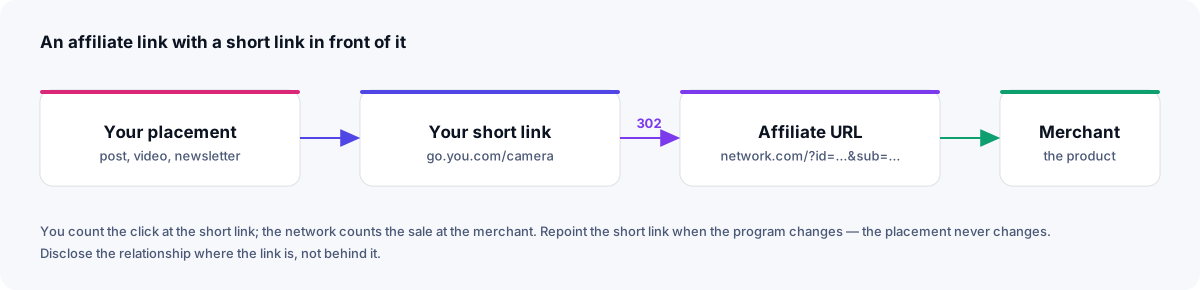
The reader taps your short link. The shortener counts the click and redirects to your full affiliate URL, exactly as the network gave it to you — ID, sub-ID, tracking parameters and all. The network's own tracking runs at the destination, unchanged. Two counts result: clicks, which you own, per short link; and sales, which the network reports, per affiliate ID or sub-ID. Put them side by side and you have earnings per placement, which is the number the whole business runs on.
Nothing about this alters the network's tracking. The short link is a door; the affiliate URL is behind it, unchanged.
go.yourname.com/camera reads as a recommendation from you. A random code on a generic shortener reads as a trap, and on some platforms is filtered as one. A custom domain is one DNS record and it does more for click-through than anything else on this page.
Not per product — per placement. The same camera gets /camera-yt for the video description, /camera-blog for the review, /camera-nl for the newsletter, /camera-ig for the bio. Same affiliate URL behind all of them (or a different sub-ID per placement, if the network supports it — see measuring, below).
This is the same rule as every other channel, and it's the only way a click count means anything.
Old affiliate content keeps earning long after you've forgotten making it. Aliases in plain words — /camera-yt, not /c1 — and a description on each link ("Sony a7 · YouTube review · March 2026 · Amazon") mean the day the program changes, you can search for every placement of that product and fix them in minutes. The naming guide has the conventions.
Before scaling, click a short link, complete a test path at the merchant if the program allows it, and confirm the click shows up in the network's reporting. Most problems — a stripped parameter, a program that forbids redirects — show up on the first link.
Networks tell you sales, sometimes clicks, per affiliate ID. What they don't tell you is which of your placements sent the sale, unless you use a sub-ID (called SubID, sid, tag, ref or similar depending on the network) — a value you append to the affiliate URL that comes back to you in the report.
The clean pattern is to make the sub-ID match the short link's alias:
go.yourname.com/camera-yt   →  network.com/?id=YOU&subid=camera-yt
go.yourname.com/camera-blog →  network.com/?id=YOU&subid=camera-blog
Now the shortener's statistics show clicks per placement, and the network's report shows sales per placement, and the two join on the alias. Earnings per click, per placement, without a spreadsheet of lookups.
What the shortener's numbers add that the network's don't:
Visitor IPs are never stored by Xlyl, which matters for an affiliate: you get the per-click detail — which placement, which country, which device — with no address in the database to leak, and nothing to reconcile with privacy rules beyond the disclosure you already make.
They always do. The product is discontinued, the commission drops, the network switches, the merchant leaves. With a raw affiliate URL in three hundred places, each is now a dead or non-paying link until you find it.
With a short link per placement, the fix is one edit per placement — or one edit total, if a group of placements points at the same alias. The video description from 2024 still says go.yourname.com/camera; today it goes to the current camera on the current program. Editable destinations are the single largest reason affiliates use a shortener.
Some habits that make this painless:
/best-camera) in addition to the per-placement links, and point it at whatever you currently recommend. It's the link you'll paste when someone asks.Shortening a link changes how it looks. It changes nothing about your obligations.
Disclose the relationship where the link appears. Consumer-protection rules in most countries — and every major platform's own rules — require that affiliate relationships be disclosed clearly and close to the link, in language a reader understands. The US Federal Trade Commission's disclosure guidance for creators is the clearest plain-English statement of what "clear and conspicuous" means, and most other regulators land in the same place. "Affiliate link" or "I earn a commission if you buy through this link" in the post, the video description, the newsletter. Not in a footer, not behind the link, not on another page. A short link with no disclosure is the same violation as a long one with none.
Follow the program's link rules. Most networks allow redirects; some forbid "cloaking" (hiding the affiliate URL), some require their own link format, some ban certain placements (paid search on the merchant's brand is a common one). The program terms are the authority. If a program forbids redirects, use its links directly for that program.
Don't obscure the destination from the reader. A short link is fine; a short link whose surrounding text pretends the destination is something else is not. Say what it is: "the camera I use (Amazon, affiliate link)".
Keep the short link honest in social bios and stories — the platforms' own disclosure tools (paid partnership labels, #ad) apply to affiliate content on many of them.
None of this is onerous, and all of it is easier with links that say what they are: go.yourname.com/camera next to "affiliate link" is clearer than a network URL with a token in it.
| Placement | Why the short link matters | Alias example |
|---|---|---|
| YouTube descriptions | Edited rarely, live for years, read aloud in the video | /camera-yt |
| Blog reviews | Long affiliate URLs break the flow; programs change | /camera-blog |
| Newsletters | Clean links get more taps; each issue is its own placement | /camera-nl-mar |
| Instagram / TikTok bio | One link, editable, branded | /links, /camera-ig |
| Podcast show notes and spoken mentions | Must be sayable and typeable | /camera |
| Printed inserts, packaging | QR code that stays valid after the program changes | /camera-print |
The social guide covers each platform's handling of links; the QR guide covers the printed ones.
/[product]-[placement].If you have hundreds of placements, the API creates the links from a spreadsheet in a few lines.
social · marketing
How Instagram, X, TikTok, LinkedIn, YouTube and WhatsApp treat links, why branded links get more taps, and how to run a link-in-bio on your domain.
· 7 min read
qr · marketing
Where QR codes get scanned, how large to print them for the distance, why the code should hold a short link, and how to measure scans per placement.
· 8 min read
marketing · analytics
Which UTM parameters to use, how short links hide the tags, why one link per channel is the rule, and how to read link and site analytics together.
· 8 min read