Product
QR code generator for links you can track and change
A QR code is a URL drawn as a picture. Generate it from a short link instead of the raw URL and you get a simpler code, click statistics for every scan, and the ability to change where it goes after it has been printed.
How to create a QR code for a URL#
1. Shorten the link#
Sign in and shorten the destination on the homepage. Give it a custom alias if it will be read as well as scanned — codes on posters usually have the link printed beneath them.
2. Open the QR code#
In your links table, click the QR icon on the link. The code appears in a dialog.
3. Download and place it#
Save the image and drop it into the flyer, menu, slide, packaging or sign. Test it with a phone before sending anything to print.
Why the short link matters for QR codes#
QR codes encode text; more text means more modules (the little squares) and a denser, more fragile code. A 90-character campaign URL with UTM parameters produces a code that needs to be printed large and scanned carefully. A 20-character short link produces a sparse code that scans from across a table.
The second reason is the one people discover too late: a printed QR code cannot be edited. If it encodes the raw URL and that page moves, every printed copy is dead. If it encodes a short link, you change the link's destination in the dashboard and every printed copy follows.
Tracking scans#
Every scan is a click on the short link, so it shows up in the link's analytics with the hour, country and device. Use one link (and one code) per placement — the table tent, the poster, the receipt — and you can see which placement is actually being scanned.
Print sizing rules of thumb#
- Minimum printed size around 2 cm × 2 cm for a short-link code; larger for anything scanned from more than arm's length.
- Keep a quiet zone — blank margin — of at least four modules around the code.
- Dark code on a light background. Inverted codes fail on many scanners.
- Print the short link as text next to the code for people who cannot or will not scan.
How large to print it#
The commonest reason a code gets no scans is that it was printed too small for where it ended up. The dependable rule is a tenth of the scanning distance, and more for poor paper or low light.
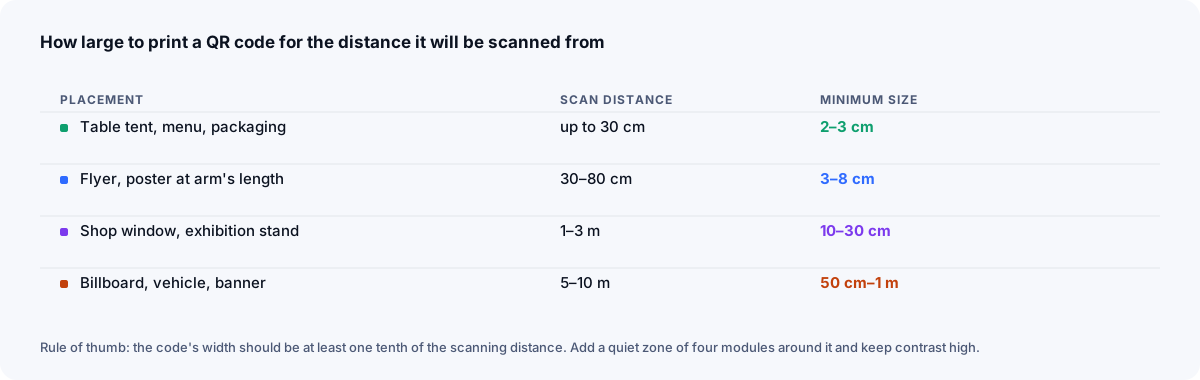
Two details decide the rest: keep the quiet zone — the blank margin on all four sides — because designers routinely crop it to fit a layout and the code stops scanning; and print dark on light, since inverted and low-contrast codes fail on many readers. The print guide covers placement, surfaces and error correction in full.
Why the code should hold a short link#
Encoding the destination directly seems simpler and costs you both things that matter. The pattern on paper is fixed forever, so the day the destination moves, the print run is wrong. And scans arrive at the destination indistinguishable from any other visit, so you never learn what the code was worth.
Encoding a short link fixes both: the destination is editable for the life of the code, and every scan is a click on a link you own, counted with the hour, country and device attached. Put it on your own domain and the printed URL beneath the code carries your name too — which is worth doing, because a readable link is the fallback for everyone who will not scan.
Frequently asked questions
- How do I get a QR code for a URL?
- Shorten the URL while signed in, then click the QR code icon on the link in your dashboard. The code is generated instantly and can be downloaded as an image.
- Why put a short link in a QR code instead of the full URL?
- Shorter text produces a simpler code with fewer modules, which scans faster and survives printing at small sizes. And because the short link is editable, you can change where the printed code goes without reprinting it.
- Does the QR code expire?
- Only if the link behind it does. A QR code is just the link encoded as an image; as long as the short link works, so does the code.
- Can I track scans of a QR code?
- Yes. A scan is a click on the short link, so it appears in the link's analytics with the time, country and device — QR scans are typically mobile.