affiliate · marketing
Short Links for Affiliate Marketing: A Practical Guide
How affiliates tidy long tracking URLs, measure which placement earns, re-point links when a program changes, and stay within disclosure rules.
7 min read
branding · marketing
How to name short links so they get clicked and found again, organise hundreds by channel and campaign, and keep a link library usable.
A custom short link is the one part of a link you get to write yourself, and it's read by more people than any headline: it's on the slide, in the tweet, under the QR code, in the email footer. The difference between go.yourbrand.com/spring-sale and go.yourbrand.com/x7Fq2 is the difference between a link that tells the reader what they'll get and one that asks them to trust you. The difference between a link library where you can find last spring's link in ten seconds and one where you can't is whether anyone bothers to reuse anything.
This guide covers both halves: how to name a single link well, and how to organise many of them so the library stays useful. It assumes you have a shortener that lets you choose the ending — Xlyl does, on its domain or yours — and that you'll be making enough links for the second half to matter.
Three things happen to a short link that don't happen to a long one.
It gets read aloud. On a podcast, in a talk, on a video, over the phone. slash spring dash sale works. slash x seven capital F q two doesn't.
It gets typed. From a printed page, a slide, a billboard. Every character is a chance to mistype, and every ambiguous character — l and 1, O and 0, a capital that might be lowercase — is a chance to lose the visitor. Google's own URL structure guidance makes the same argument for site URLs: readable words beat opaque identifiers.
It gets judged. Before anyone clicks, they read the address and decide whether it looks like something they want. A descriptive alias on a branded domain is a promise about the destination; a random code is a shrug.
So the goal of naming is simple to state: a stranger should be able to hear the link once, type it correctly, and know roughly what they'll find.
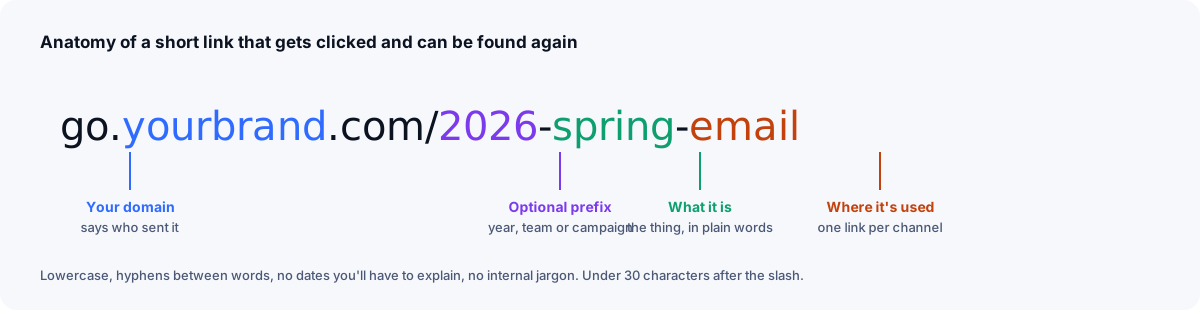
Name the thing, not the campaign brief. /menu, /pricing, /webinar, /spring-sale, /annual-report. If a colleague would call it "the September menu", the link is /menu or /sept-menu, not /f-and-b-collateral-q3.
The test: would the reader guess roughly right from the alias alone? If yes, it's descriptive. If they'd need the context of your message to make sense of it, it's a code with extra steps.
Use lowercase letters, digits and hyphens. Nothing else.
/Spring and /spring as different links, and because people typing from print won't know which you meant.Under about 30 characters after the slash is a good ceiling; two or three words is the sweet spot. /spring-sale is better than /ss (which nobody can guess) and better than /spring-sale-2026-email-campaign-v2 (which nobody will type).
If a link will be printed or spoken, avoid aliases where a mistype is easy: l/1/I, O/0, rn/m. Use whole words and the problem mostly disappears; /menu can't be misread, /m3nu-0l can.
A date in the alias is fine when the date is the content — /report-2026 for an annual report. It's a trap when you'll want the same link next year: /spring-sale-2026 either lies in 2027 or has to be replaced, and replacing a link means every place it was printed is now wrong. Prefer /spring-sale and change where it points when the sale changes. The whole reason to use a shortener is that the destination can move while the link stays still; a name that has to move too gives that up.
Don't reuse an alias for a different thing because it's free. If /webinar pointed at March's session, pointing it at October's is fine — same purpose, new instance. Pointing it at your pricing page because you've no other use for it will confuse everyone who saved the old one.
Naming well is enough for a dozen links. At a hundred, you need a system, and the system has to survive the person who invented it leaving.
Most confusion in link libraries comes from links that serve two purposes at once. The clean rule is one link per placement: the same destination gets a different short link for the newsletter, the Instagram bio, the printed flyer and the sales deck. That's more links, but each one's click count now means something — it's the count for that placement — and the campaign tracking guide is built on exactly this idea.
Pick an order for the parts of an alias and keep to it. A shape that works for most teams:
/[what]-[where]            → /spring-sale-email, /spring-sale-ig
/[what]-[when]             → /webinar-oct, /report-2026
/[team]-[what]             → /sales-deck, /support-faq
Whichever you choose, the "what" comes first, because that's what people search for and how they'll remember it. Suffixes for the channel — -email, -ig, -print, -qr — are short, obvious and easy to filter on.
Every link in Xlyl has a description. Use it for what the alias can't hold: the campaign, the owner, the date it was made, the offer code inside the destination. The dashboard's search covers the target, the alias and the description, so a note like "Spring 2026 · newsletter · owner: Maya" makes the link findable three different ways.
If several people can create links on go.yourbrand.com, agree the shape above and write it down where they'll see it — a pinned note, a wiki page, the description of the first link. A library with two naming systems is worse than one with none.
Links that were never shared can go. Links that were printed, mailed or posted should stay — and if the destination is gone, point them at something useful (the current version, a "this offer has ended" page, the homepage) rather than letting them 404. A short link is a promise; keeping old ones working is cheap and the alternative is a dead end with your name on it. Give links that were only ever meant to be temporary an expiry at creation, so you never have to remember.
Everything above concerns the part after the slash. The part before it — the domain — is chosen once and matters at least as much.
A custom domain puts your name on every link, which is what makes readers trust and click it. The choice of domain is a naming decision too:
go.yourbrand.com, l.yourbrand.com — is the safest. It's obviously yours, and the trust in your main domain carries over.ybr.nd, yourbrand.link — is shorter still and looks deliberate, at the cost of a registration and a little explanation.Set it up once; every link after that is yours/what-it-is. The domains page checks the DNS live so you'll know it's pointing at the right place before the first link goes out.
| Before | After | Why |
|---|---|---|
xlyl.link/x7Fq2 |
go.cafe.com/menu |
Says what it is, on your domain |
/SpringSale2026Email |
/spring-sale-email |
Lowercase, hyphens, no date to outlive |
/promo |
/spring-sale-ig |
One link per placement; the count means something |
/link1, /link2 |
/webinar-oct, /webinar-slides |
Names you'll find again |
/q3-fb-collateral-v2 |
/report-2026 |
The reader's words, not the brief's |
Before you create a link, run it past these:
Six seconds per link, and the library stays usable for years.
affiliate · marketing
How affiliates tidy long tracking URLs, measure which placement earns, re-point links when a program changes, and stay within disclosure rules.
· 7 min read
social · marketing
How Instagram, X, TikTok, LinkedIn, YouTube and WhatsApp treat links, why branded links get more taps, and how to run a link-in-bio on your domain.
· 7 min read
qr · marketing
Where QR codes get scanned, how large to print them for the distance, why the code should hold a short link, and how to measure scans per placement.
· 8 min read