Product
Using a URL shortener with your own custom domain
Branded short links get clicked more than generic ones, because people can see where a link goes before they trust it. Here is how to point your own domain at your links.
Why a branded domain matters#
A generic shortened link hides its destination. Recipients have learned to be wary of them, and some corporate mail filters treat unknown shortener domains as a spam signal. A link on your own domain carries the trust your brand already has, and keeps that recognition in every place the link is shared.
It also means you own the links. If you ever move to a different shortener, you can repoint the domain and every link you have ever published keeps working.
What you need#
- A domain or subdomain you control — a subdomain such as
go.yourbrand.comis the usual choice - Access to that domain's DNS settings
- A Xlyl account — sign up here
Setting it up#
1. Point the DNS record#
In your DNS provider, create an A record for the subdomain you want to use, pointing at 104.207.76.203.
| Type | Name | Value |
|---|---|---|
| A | go | 104.207.76.203 |
Use @ as the name instead of go if you are pointing an entire root domain rather than a subdomain.
2. Add the domain to your account#
Open Domains and enter the domain. You can optionally set a homepage — where someone is sent if they visit the bare domain with no link code after it. Leave it blank and they are redirected to Xlyl.
3. Wait for DNS to propagate#
DNS changes are not instant. They usually take effect within a few minutes, but can take up to 48 hours depending on the TTL your provider uses. Until then the domain may work for you and not for someone else — that is normal and resolves itself.
4. Create a link on it#
Back on the homepage, open Show advanced options and pick your domain from the dropdown. The short link you get back will use it.
Troubleshooting#
The domain shows a certificate warning#
HTTPS for a custom domain needs a certificate covering that domain. If you are self-hosting, issue one — for example with Let's Encrypt — and make sure your reverse proxy serves it for the new hostname.
The domain loads the wrong site#
Check there is no conflicting CNAME or existing A record for the same name. A subdomain can only have one A record; an old record left in place will keep winning.
I get redirected instead of seeing my link#
Visiting a custom domain with no link code after it redirects to the homepage you configured, or to Xlyl if you left that blank. That is expected — custom domains serve links, not a copy of the site.
Which record to add#
Two shapes cover almost everyone. Use a subdomain unless the whole domain exists to be the short domain.
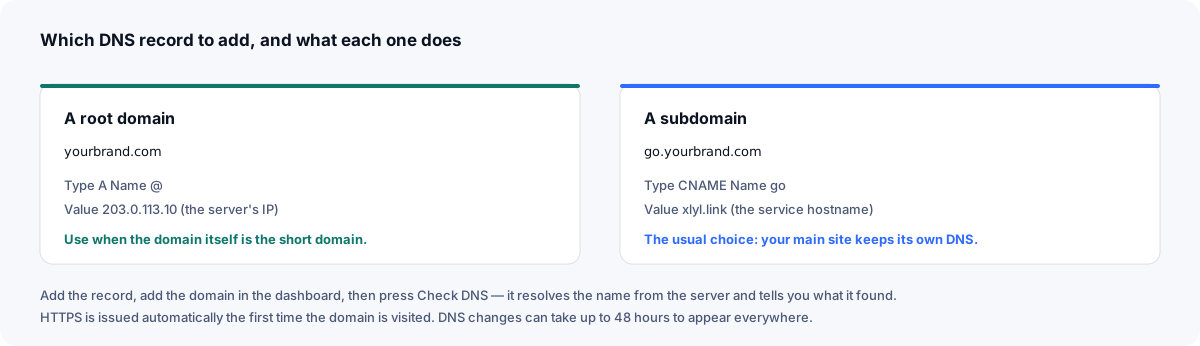
A subdomain is the usual choice because it leaves your main website's DNS untouched: go.yourbrand.com or l.yourbrand.com points here while yourbrand.com carries on exactly as it did. A dedicated short domain is shorter still, at the cost of another registration.
Checking it worked#
The domains page lists the records to set, and every connected domain has a Check DNS button that resolves the name from the server and reports what it found — the addresses, or the fact that nothing is there yet.
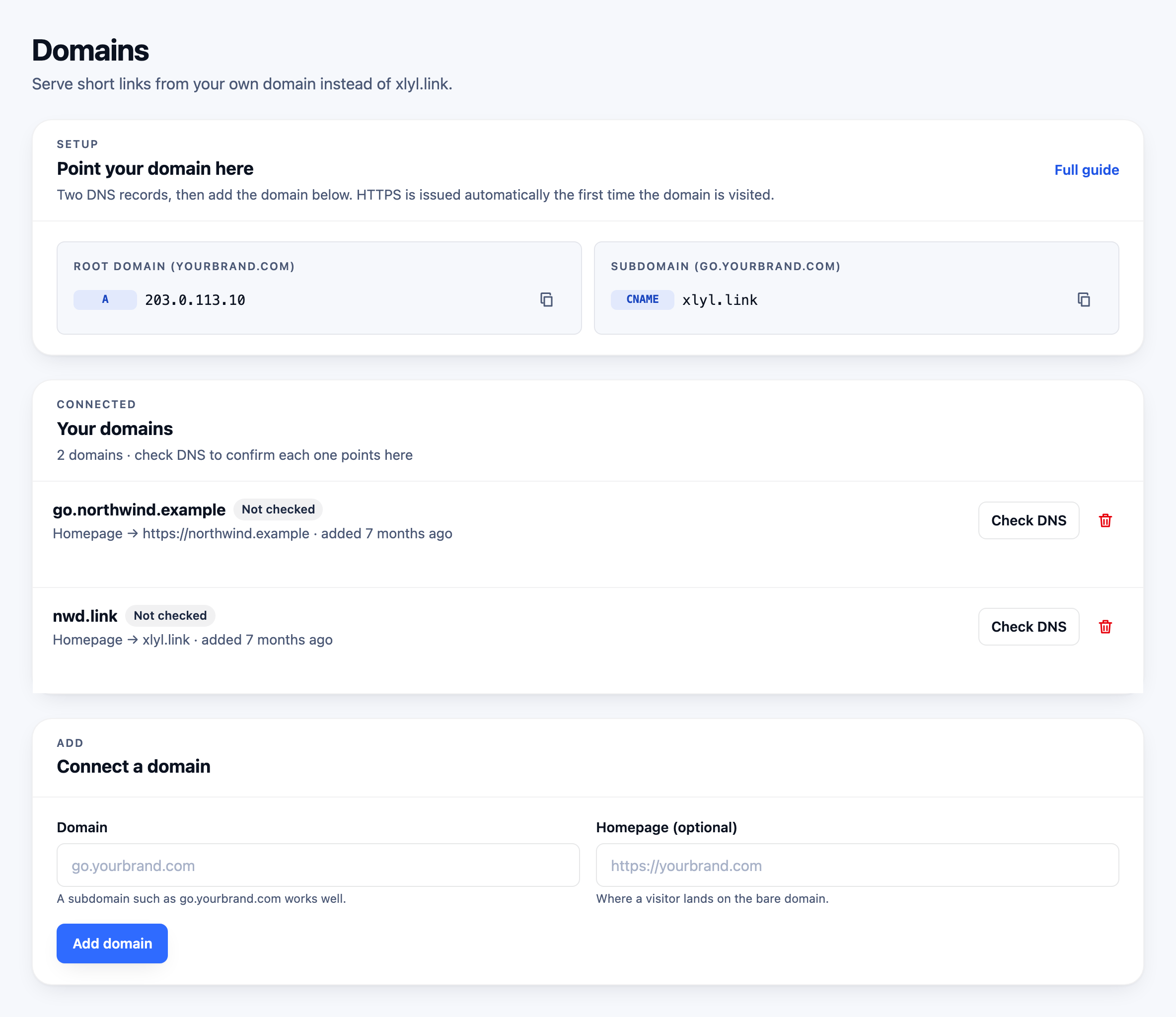
This matters because DNS is the step people get wrong and the step with the slowest feedback: a typo can take hours to become obvious. Checking from the server, rather than trusting your own machine, rules out a local resolver cache telling you what you want to hear. Propagation can take up to 48 hours, so an empty result immediately after a change is normal.
After the domain is live#
Choose it in the advanced options when you shorten a link, and the link is created on it. Aliases are unique per domain, so every ending you want is available on yours even if it is taken on the shared domain — which is the moment to agree a naming convention rather than after the first hundred links.
From here, the rest follows: clicks are counted per link, QR codes encode the branded link so printed codes stay valid, and the API can create links on the domain from a script. If you later move to another service, the domain moves with you — which is the argument for owning it in the first place.
Frequently asked questions
- Do I need to buy a new domain?
- No. A subdomain of a domain you already own works, and is what most people use — for example go.yourbrand.com or link.yourbrand.com. That keeps your main domain untouched.
- Can I use more than one custom domain?
- Yes. You can add several domains to one account and choose which one a link uses when you create it.
- What happens to links on my old domain?
- Nothing — they keep working. Adding a custom domain does not move or rewrite links you already created.
- Does a custom domain change my analytics?
- No. Clicks are tracked per link regardless of which domain serves it, so your statistics are unaffected.