Comparison
A Rebrandly alternative for branded links
Rebrandly built its product around one idea: a short link should carry your brand, not the shortener's. That idea is right, and it is the same one behind this tool. The difference is where branded links sit — the centre of a paid platform built for teams, or an included part of a free one built for individuals and small teams.
What Rebrandly does well#
Rebrandly is not a generic shortener with branding bolted on — it is a branded-link platform, and that focus shows. Domain management is its strongest area: connecting, verifying and running many domains across a team is a genuinely fiddly problem and it handles it properly.
Around that sit the things a marketing organisation actually needs once more than two people are making links: shared workspaces with roles and permissions, single sign-on, approval workflows, and integrations that put link creation inside the tools a team already works in. If several people create links under one brand and someone is accountable for what goes out, that machinery is the product, and no free tool replaces it.
Where the two differ#
What the free tier is for#
On a commercial branded-link platform, the free tier is an evaluation: enough to see the idea work, with the volume, domains and team features that make it usable at work on the plans above. Tier contents change, so verify anything you plan to depend on against Rebrandly's own pricing page.
Here there is one tier. Branded domains, chosen endings, editable destinations, analytics, QR codes and the API are all in it; the only limits are anti-abuse ones. The free-tier page sets out exactly what those are.
Teams versus individuals#
This is the honest dividing line, and it is not about features so much as about accountability. Xlyl has accounts, not organisations: no shared workspace, no roles, no per-user permissions, no approval step before a link goes live. Several people can use one account, but the tool will not tell you who made which link.
If that matters — because links go out under a brand and someone signs off on them — Rebrandly is built for it and this is not. If your link library is effectively one person's responsibility, the machinery is overhead you are paying for.
Ownership and the exit#
Both products serve links from domains you register, which means the most important property is the same in each: the links are portable.
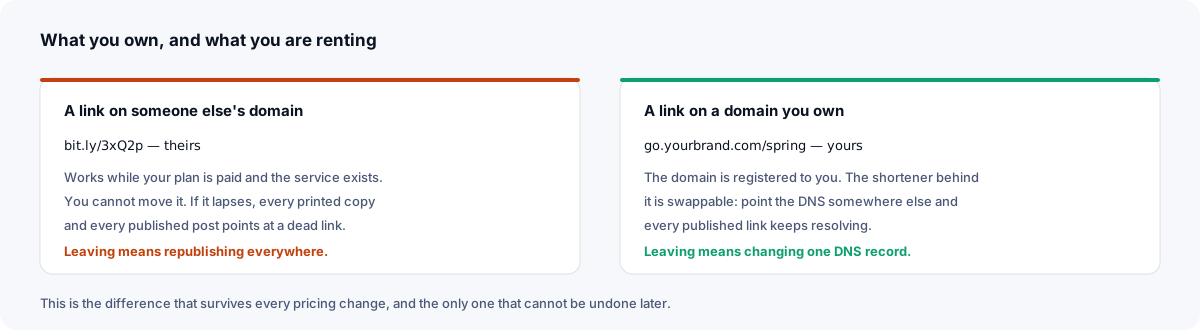
The difference is what happens underneath. Xlyl is open source, so the exit is not only "move to another vendor" but also "run this yourself" — same software, your server, your database, and the links unchanged. With any proprietary platform the exit is always a migration to someone else.
What is stored about visitors#
Xlyl records the detail of each click but never the visitor's IP address, so there is no address to retain, export or lose. That buys a short answer to security questionnaires and costs the kind of per-visit segmentation a platform with a full visit log can offer. Which side of that trade you want is worth deciding before you compare feature lists.
Agencies and several brands at once#
A large share of branded-link users are agencies, or in-house teams running more than one brand. It is worth being precise about what works here and what does not, because the answer is genuinely mixed.
What works. Multiple domains on one account are free and unlimited in practice, and each domain keeps its own alias namespace — so go.clienta.com/spring and go.clientb.com/spring coexist without a clash, which is exactly the problem that bites when you run campaigns for several brands with the same seasonal vocabulary. Every link carries a description field, and the dashboard searches target, alias and description together, so a naming convention plus a client prefix gives you a workable library. The naming guide sets out a convention worth agreeing before the first hundred links.
What does not. There is no separation by permission — only by convention. One account holds every client, so anyone with the login can see and edit every link, and the tool will not tell you who changed what. There is no way to hand a client read-only access to their own links, no approval step, and no audit trail if a destination is repointed. For a solo operator or a small studio that is usually acceptable. For an agency with staff turnover and client contracts that specify access control, it is not, and that is a reason to pay for a platform built around workspaces.
The practical middle path some people use is one account per client, each with that client's domain. It is more logins to manage, but it gives real separation and means handing over the account is a clean way to hand over the links at the end of a relationship.
Side by side#
| Capability | Rebrandly | Xlyl |
|---|---|---|
| Branded domains | Core product; count varies by plan | Included, several per account |
| Custom alias | Yes | Yes, 1–64 characters |
| Edit destination after sharing | Yes | Yes, any time |
| Click analytics | Depth and retention by plan | Full per-link breakdown, bots filtered |
| Password protection | Not a standard feature | Included |
| Expiring links | Plan-dependent | Included |
| QR codes | Yes | Included |
| API | Yes, limits by plan | Included, full coverage |
| Workspaces, roles, SSO | Yes | No |
| Marketing tool integrations | Extensive | API only |
| Self-hostable | No | Yes, open source |
Rebrandly's column describes the shape of its offering rather than a named plan. Verify specifics on their pricing page.
Moving a branded domain across#
Because the domain is yours, this is the easy direction of travel and nothing you published has to change.
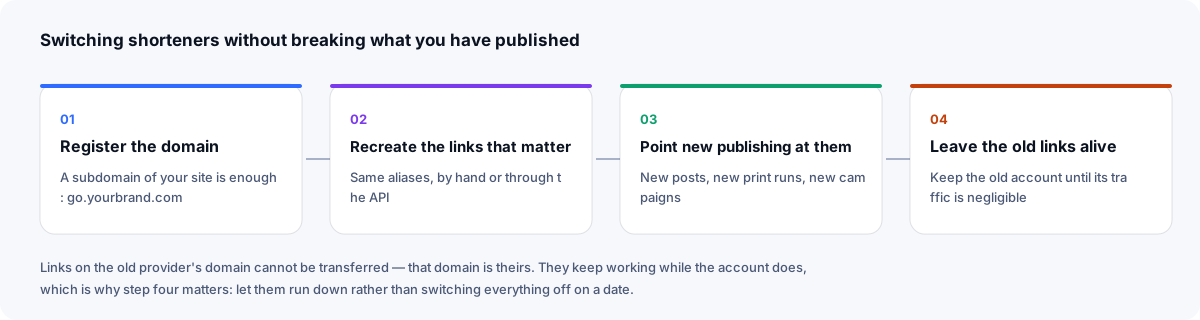
- Export your link list so you know which aliases still earn their place.
- Add the domain on the domains page and recreate the aliases — by hand, or with the API for a long list.
- Change the DNS record to point here. Use Check DNS to confirm it resolved; HTTPS is issued automatically on the first visit.
- Keep both accounts briefly. Once traffic on the old one has stopped, close it.
Recreate the aliases before switching the DNS and the changeover is seamless: the moment the record propagates, the same links resolve here. The custom domain guide covers the DNS side in detail.
Who should choose which#
Choose Rebrandly if links are a team activity — several people creating under one brand, with roles, sign-off, single sign-on, and integrations into the tools they already use. That is a real product requirement and this tool does not meet it.
Choose this if branded links are the requirement and the team machinery is not: you want your domain on every link, analytics you can trust, the ability to change a destination after it is printed, and no monthly bill — with the option to run the software yourself if you ever want to stop depending on anyone at all.
Frequently asked questions
- Is there a free Rebrandly alternative with custom domains?
- Yes. Branded links on your own domain are part of the single free tier here — one DNS record, added in settings, with HTTPS issued automatically the first time the domain is visited. There is no plan above it to unlock anything.
- Can I use several branded domains on one account?
- Yes. Add as many as you need and choose which one a link uses when you create it. Each domain has its own alias namespace, so the same ending can exist on two of your domains without clashing.
- Do I need a paid plan for link analytics?
- No. Every link has its own statistics page: clicks by hour and day, referrer, country, browser and operating system, with bots filtered before counting and no visitor IP addresses stored.
- What does Rebrandly do that this does not?
- Team workspaces with roles and permissions, single sign-on, deep integrations with marketing and sales tooling, link-level approval workflows, and a commercial support relationship. If your requirement list includes those, that is a genuine reason to choose it.
- Can I move branded links from Rebrandly?
- If the links are on a domain you registered, yes — point the domain here, recreate the aliases, and everything published keeps resolving. That portability is a property of owning the domain, not of either product.