Product
Custom URL shortener: short links you name yourself
A random code tells the reader nothing. A custom short link — an alias you chose, on a domain you own — tells them where they are going and who is sending them. Here is how to make one.
Random codes versus custom aliases#
Paste a URL into any shortener and you get something like xlyl.link/kZHTt5. It works, but it is opaque: nobody can tell what it is, remember it, or say it out loud. A custom link replaces the code with a word you chose — xlyl.link/spring-sale — and, with a custom domain, the whole thing becomes go.yourbrand.com/spring-sale.
Studies from link platforms consistently show branded links earning more clicks than generic ones, for the obvious reason: people click what they can read. The difference matters most in print, on slides, in podcasts and anywhere the link has to be typed rather than clicked.
How to create a custom short link#
1. Sign in#
Custom aliases are tied to an account so they can be edited and tracked. Sign up takes an email and a password.
2. Open advanced options#
On the homepage, tick “Show advanced options” under the URL field. You will see fields for the domain, the custom address, a password, an expiry and a description.
3. Type the alias#
Enter the ending you want in “Custom address”. Letters, numbers, hyphens and underscores, up to 64 characters. If the alias is already taken on that domain you will be told immediately.
4. Choose a domain (optional)#
If you have added a custom domain in settings, pick it from the dropdown; the alias is then unique on that domain rather than the shared one. The custom domain guide covers adding one.
Naming custom links well#
- Say what it is.
/pricingbeats/p1. The reader should know the destination before clicking. - Keep it short and typeable. Hyphens are easier to read aloud than underscores; avoid mixing case, since aliases are case-sensitive.
- Use a pattern.
/webinar-jan,/webinar-feb. Consistent naming makes the dashboard searchable months later. - Add a description. It is not part of the link, but it is what you will search for when you need it again.
Change the destination, keep the link#
The strongest reason to use custom links is that they are editable. A printed alias like /menu can point at a new PDF every season; a /signup link on a business card can follow you to a new form tool. Edit the target in the dashboard and every copy already in the world updates instantly, because the short link itself never changed.
Anatomy of a link worth reading aloud#
A custom link gets read in places a long URL never does: on a slide, in a podcast, off a printed card. That is the standard it has to meet — a stranger should be able to hear it once, type it correctly, and guess roughly what they will find.
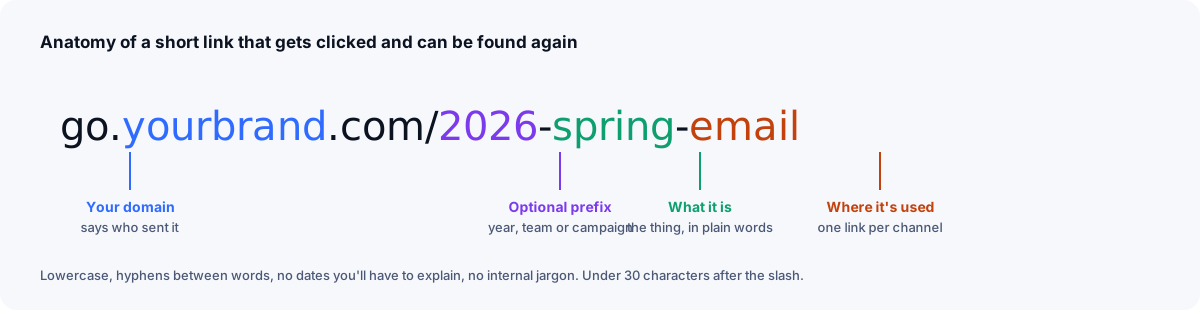
Lowercase, hyphens between words, no punctuation, and nothing that will be wrong next year. Ambiguous characters are the quiet killer: avoid aliases where a reader has to decide between l and 1, or O and 0, and the problem disappears on its own if you use whole words. The naming guide has the full conventions, including how to organise hundreds of them once one person is no longer the only one making them.
In the dashboard#
Every link keeps its alias, target and description in one row, all editable, and the table searches across all three — which is how you find a link you made last spring without remembering what you called it.
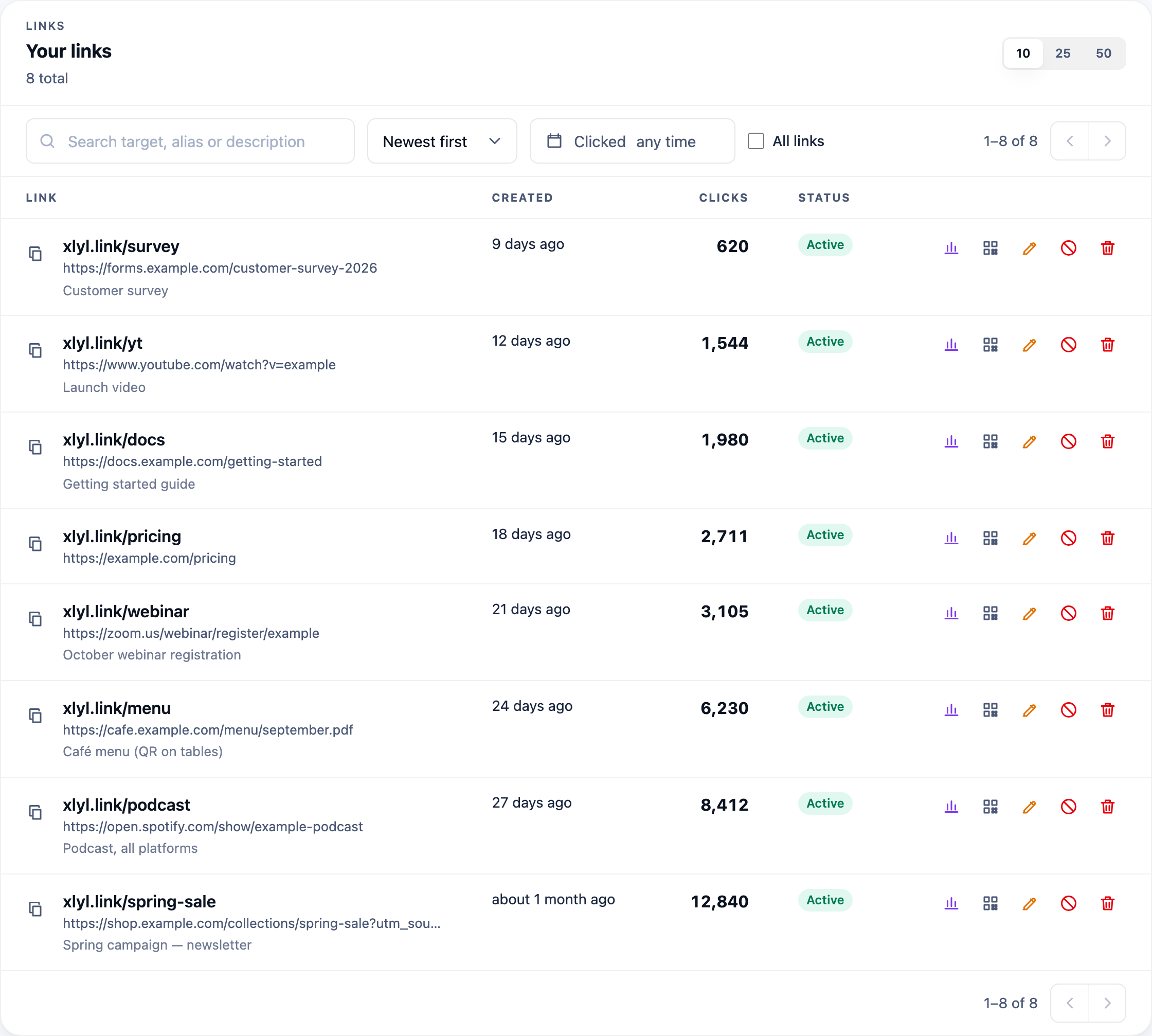
The ending is chosen when you create the link and can be changed afterwards — though once a link is published, changing the alias breaks what was shared, so the better move is usually to keep it and change where it points instead.
Frequently asked questions
- What is a custom short link?
- A short link whose ending you chose — yourdomain.com/spring-sale instead of a random code. The destination can still be changed later without changing the link.
- What characters can a custom alias contain?
- Letters, numbers, hyphens and underscores, between 1 and 64 characters. Aliases are case-sensitive and unique per domain.
- Can two people use the same alias?
- Not on the same domain. On different custom domains, yes — /sale on go.brand-a.com and /sale on go.brand-b.com are separate links.
- Can I change a custom link's destination after sharing it?
- Yes. Edit the target from your dashboard and every existing copy of the link starts sending visitors to the new destination.