Comparison
A free Bitly alternative: Xlyl compared honestly
Bitly is the default for good reasons, and most people who leave are not unhappy with it — they have hit the edge of the free tier, usually at the custom domain. Here is what genuinely differs between the two, what Bitly does better, and how to move without breaking anything you have already published.
What Bitly does well#
Worth saying first, because a comparison that only lists a competitor's shortcomings is an advertisement, not a comparison.
Bitly has been doing this for well over a decade, and that shows in the places it is hard to compete: uptime and redirect latency at enormous scale, a link domain that every mail filter and security product on earth already trusts, integrations built into the marketing tools teams already run, and an organisation you can buy a contract from. For a marketing department with a procurement process, those are not luxuries — they are the requirements list, and no free tool satisfies them.
Its analytics are also more elaborate than ours: campaign grouping, team dashboards and reporting features that go beyond what a per-link breakdown gives you. If a team of a dozen people needs shared workspaces and role-based access, that is a real product requirement and this is not the tool for it.
Where the two genuinely differ#
The pricing model, not the price#
Bitly is freemium: a free tier that works, with the features most businesses eventually need arranged on the plans above it. Specific caps and tier contents change — verify them on Bitly's pricing page rather than trusting any comparison page, including this one.
Xlyl has one tier and it is free. Everything on the features page is available to every account. The limits that exist are anti-abuse — a daily creation cap per account, a cooldown for anonymous links — not commercial ones, and they are documented rather than discovered.
Who owns the link#
This is the difference that cannot be undone later.
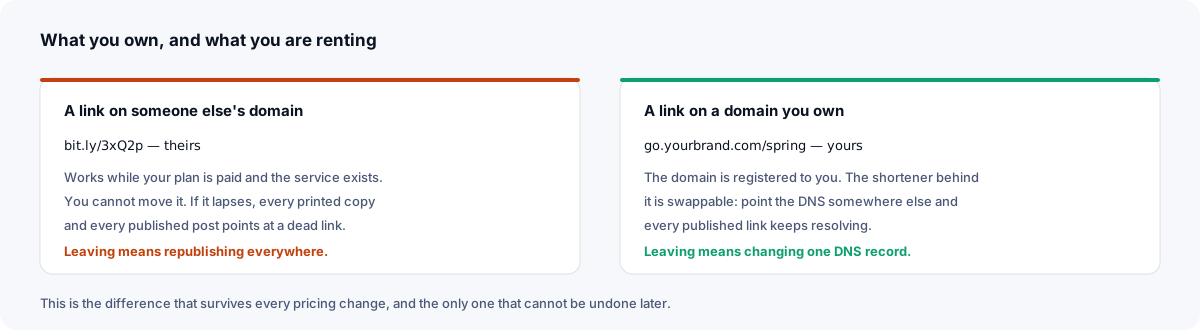
A bit.ly link is Bitly's address with your destination behind it. It resolves while your account does. A link on go.yourbrand.com is yours, whoever operates the shortener behind it: if you leave, you repoint the domain and every printed card, old newsletter and embedded QR code keeps working. The custom domain guide is a five-minute job, and the domains page checks the DNS live so you know it resolved before the first link goes out.
What is kept about your visitors#
Commercial analytics are usually built on per-visit records keyed to an address, which is what makes deep segmentation possible and also what creates a retention policy, a data-processing agreement and a breach surface. Xlyl keeps the per-click detail — campaign, channel, device, city — but never the address: repeat visits are counted through a hash whose salt is replaced daily and never stored. You get the breakdown without there being an address in the database to export, subpoena or leak.
Whether you can run it yourself#
Xlyl is open source. If the hosted instance ever stops suiting you, the same software runs on your own server with your own database, and the links do not change. There is no equivalent escape hatch with a proprietary service — the exit is always a migration.
Feature comparison#
Structural rather than plan-by-plan, for the reason above: tier contents change, models do not.
| Capability | Bitly | Xlyl |
|---|---|---|
| Short links | Yes, on bit.ly or a custom domain | Yes, on the shared domain or your own |
| Custom domain | On paid plans | Included, several per account |
| Custom alias | Constrained on the free tier | Included, 1–64 characters |
| Edit destination after sharing | On paid plans | Included, any time |
| Click analytics | Depth and retention scale with the plan | Hour, day, referrer, country, browser, OS; bots filtered |
| Password-protected links | Not a standard feature | Included |
| Expiring links | Not a standard feature | Included |
| QR codes | Yes, with plan-dependent customisation | Included, encodes the short link |
| API | Yes, rate limits by plan | Included, one key, full coverage |
| Team roles, SSO, audit logs | Yes, on higher tiers | No |
| Support commitment | Yes, contractual on paid plans | No — community and issue tracker |
| Self-hostable | No | Yes, open source |
Bitly's column describes the shape of its offering rather than a specific plan, because plan contents change. Check their pricing page for anything you intend to rely on.
Moving across without breaking anything#
Treat it as a change of default rather than a migration. Nothing has to happen on a date.
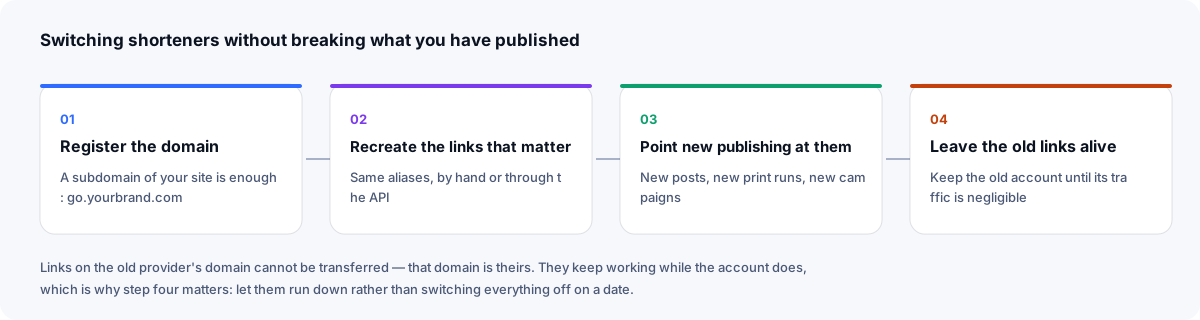
- Create an account and add your domain on the domains page. Use Check DNS to confirm it resolves here before you rely on it.
- Export your links from Bitly. That file is your inventory: it tells you which links still get traffic and therefore which are worth recreating.
- Recreate the ones that matter with the same endings, by hand or through the API. Agree a naming convention before you start, not after the first hundred.
- Point new publishing at the new links, and leave the old account open while its links still receive traffic. bit.ly links cannot be redirected to yours — that domain is Bitly's — so let them run down rather than switching them off.
If your Bitly links were already on your own custom domain, this is simpler still: change the DNS record, recreate the aliases, and every published link keeps working with no republishing at all.
Who should stay with Bitly#
If any of these is on your list, stay where you are — no amount of free is worth failing a requirement:
- A support contract with a response-time commitment, or a named account manager.
- Single sign-on, audit logs, or role-based access for a team that shares a link library.
- Integrations that already sit inside the marketing tools your team uses daily.
- A procurement or security process that requires a vendor questionnaire, a DPA and a company on the other end of it.
If instead you want branded links you own, analytics you can trust, and no bill, shorten one link and see what the page gives you — no account needed for a plain one. The comparison framework covers the same ground for other products, and the free-tier page sets out exactly which limits exist here and why.
Frequently asked questions
- Is there a free alternative to Bitly with custom domains?
- Yes. A custom domain is part of the single free tier here: add one DNS record, add the domain in settings, and every link you create can live on it. There is no plan to upgrade to, because there is only one plan.
- Can I transfer my Bitly links to another service?
- Links on bit.ly itself cannot be transferred, because that domain belongs to Bitly. Links on a custom domain you own can: point the domain at the new service and recreate the aliases, and everything you published keeps resolving. Export your link list first — it is the record of what to recreate.
- What happens to my Bitly links if I stop paying?
- Check Bitly's current terms, as this is the detail that matters most and the one that changes. In general, on any provider, links on that provider's shared domain depend on the account remaining in good standing, while links on a domain you own do not.
- Does this Bitly alternative show ads on the redirect?
- No. There is no advertising, no interstitial and no countdown anywhere between the click and the destination — not on any tier, because there is only one.
- Is a free shortener good enough for a business?
- For creating, branding, measuring and editing links, yes. For a procurement process that requires single sign-on, audit logs, a support contract or a named account manager, no — and that is the honest reason to stay with a commercial vendor.